
Hairdressing
Shears that cut hair rather than push it
When the blades no longer meet, the stylist grips harder, hundreds of times a shift. Shears are stripped, sharpened on both blades and re-tensioned; a convex pair gets its own treatment.
What is sharpened
- Convex-ground hairdressing shears
- Bevel-edged hairdressing shears with a microbevel
- Thinning and texturising shears
- Shears with a razor-ground cutting edge
- Straight razors for barbershops
- Clipper blade sets (cutter and comb together)
-
The shears fold the hair instead of cutting it
The end of the hair escapes ahead of the blade and folds over rather than being cut through. The line does not come out clean, the section is uneven, and the client notices the split ends at home in front of a mirror rather than in the chair. The cause is usually tension and the fit of the blades, not bluntness on its own.
-
The hand pays for a bad pair
When the blades do not run against each other properly, the difference is made up by the fingers. A few hundred cuts per client, several clients a day — by the end of the shift the thumb and forearm feel it, and over the years the tendons do. A pair that cuts without force is a matter of occupational health, not comfort.
-
Bad sharpening destroys a pair that cost several hundred euros
A convex pair pushed across a wheel at a flat angle comes back with a geometry its maker never gave it, and that cannot be undone. Anyone who also grinds the ride line leaves you with shears that will fold hair for the rest of their working life.
-
The clipper blade set runs hot and drags
A dull blade set needs more force and creates more friction. The work slows down, the blade heats up, and the client starts shifting in the chair. A cutter and comb that no longer sit together also leave uneven steps that have to be corrected by hand.
How the sharpening works for this trade
Why hairdressing shears go dull the way they do
Hair does not wear hairdressing shears out — hair is soft. Friction of steel against steel does. The two blades run against each other all day: the cutting edge rolls over to one side, the ride line polishes smooth, and the screw works loose by a fraction. The pair still looks immaculate, but it no longer takes hold of the hair. The rest comes from whatever finds its way between the blades: a clip, a band, a drop onto a tiled floor, dry cutting driven with force. Each leaves a chip you can barely see but feel on every cut.
What the wear looks like
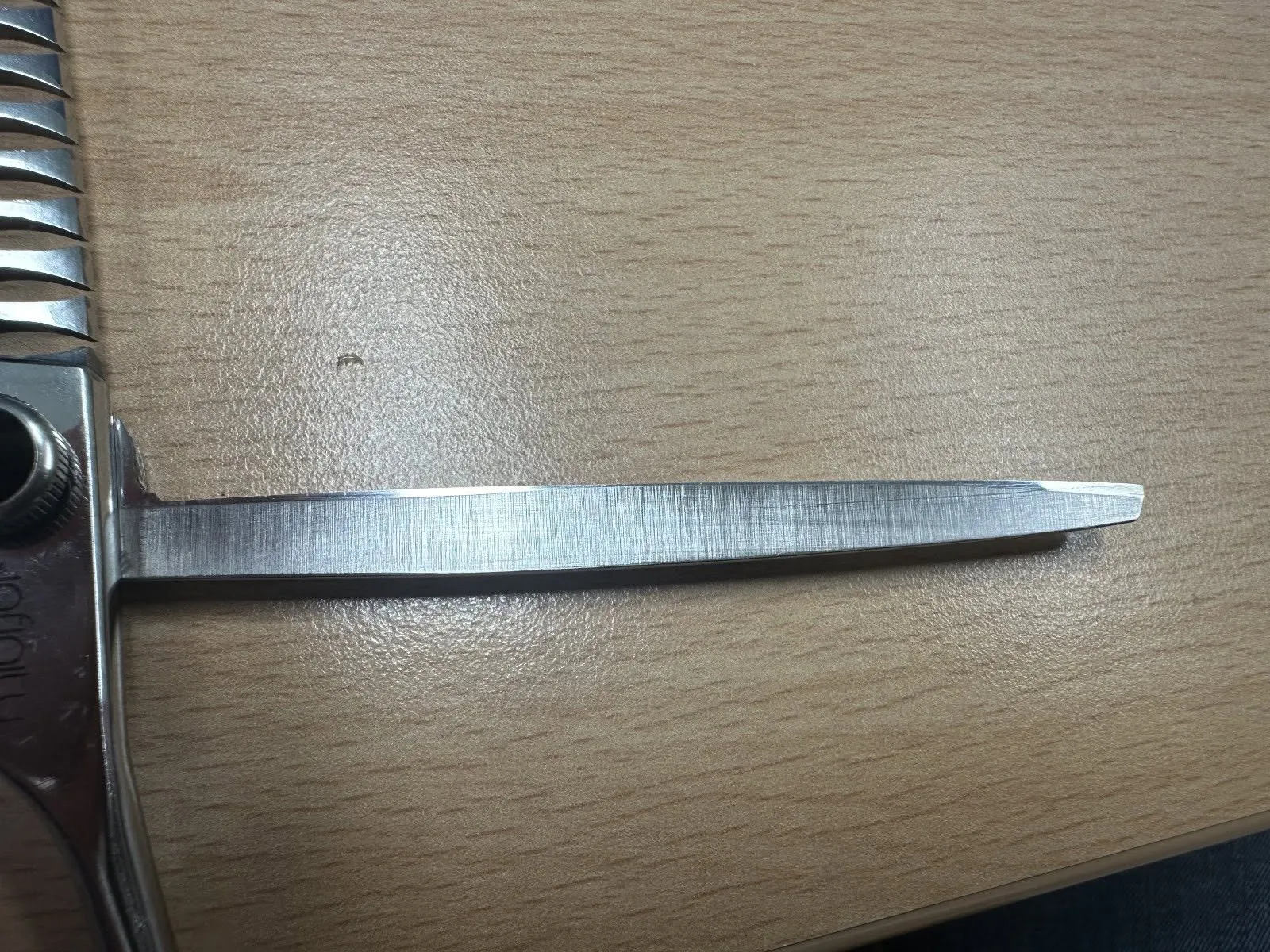
A rolled edge shows up in the salon as pushing: the hair escapes ahead of the blade and folds over instead of being cut. A chipped edge announces itself as a skip in the same place every time, where a few hairs always come through uncut. Wrong shear tension shows differently: the shears close on their own or catch as they open, and towards the end of the stroke the blades part and fold the hair. On thinning shears the wear shows as uneven removal, because the flat blade no longer sits against the toothed one.
Convex and bevel edges are not the same job
Convex-ground shears carry a gently curved bevel with no sharp transition, and it is that shape which gives them their quiet, sliding cut. Push such a pair across a wheel at a flat angle and it comes back with a flat bevel: it will cut keenly for a week, then start crushing hair, and the original geometry cannot be restored. Bevel-edged shears want the opposite — one consistent angle along the whole cutting edge and a clean microbevel. So every pair is first read for what its maker gave it, and the work follows that.
The ride line is left untouched. That is a rule without exceptions: grind it and the damage cannot be repaired, because from then on the blades can never meet again. The pair will fold hair no matter how keen the cutting edge is.
What correct sharpening restores
Servicing a pair is not one pass across a wheel. The shears are stripped and cleaned — the pivot collects a paste of hair, spray and oil that ruins the action by itself. Both blades are sharpened in stages, from coarse to fine grit, at a controlled angle and with cooling so the steel does not lose its hardness; overheated steel is not repaired by any later sharpening. The burr is removed and the bevel finished by polishing, because a smooth bevel tears less. Finally the pair is reassembled and set to a tension at which the blades stay together through the stroke and the shears do not close under their own weight.
How often sharpening is realistically needed
The measure is not the calendar but hours in the hand and how much dry cutting is involved: a pair worked several hours every day comes round more often than one kept in rotation. Do not wait until the shears fail outright — the further the edge is worn, the more material has to come off and the shorter the pair’s remaining life. Between services, do not touch shears up with consumer sharpening gadgets; on hairdressing shears they do more harm than good.
Before you drop the tools off or post them
Gather every pair at once, including the ones in the drawer nobody reaches for any more. Wipe the shears dry, clear the hair out of the pivot, and send them assembled and closed with their original screw; the blades are a matched pair and are never sent separately. Send clipper blade sets complete. Wrap each piece on its own, never as a bundle. Say how you work with the pair — dry or wet cutting, slide cutting, a lot of texturising — and whether it has been sharpened before and by whom. That tells more than a photograph. Arrange drop-off at Ferrarska ulica 14 in Koper in advance via +386 51 659 600 · igor.komadina@t-2.net; the same address applies for post.
Common questions
Do you sharpen convex-ground Japanese shears?
Yes. Every pair is first assessed to establish the geometry the maker gave it, and the work follows that geometry: a convex bevel stays convex, a flat one stays flat with its own microbevel. The ride line is not touched. If the original geometry could no longer be preserved, you are told before the work rather than after it.
What does it cost and how long does it take?
Prices are starting figures, for example from EUR 10, confirmed after assessment — a merely worn pair and a chipped one cannot honestly be put on the same line. The indicative turnaround is 1–3 working days. VAT is not charged pursuant to Article 94(1) of the Slovenian VAT Act (ZDDV-1); the price you see is final, and VAT-registered buyers have no input VAT to deduct.
How often do shears need sharpening?
It depends on hours in the hand and how much dry cutting you do. A pair worked several hours every day comes round more often than one kept in rotation with others. More reliable than the calendar is the feel in your hand: when the same cut takes more grip than it did last month, it is time.
What do I send with a clipper?
Send the clipper blade set complete, cutter and comb together, because they are sharpened and matched as a pair. There is no need to send the clipper itself. If you have several identical blade sets, mark them so they come back identifiable.
What if a pair cannot be saved?
Some pairs are past the point: blades ground away to nothing, a cracked bevel, overheated steel, a ride line that has been ground off. When that is the case you are told before the work, together with an honest view of what sharpening would still achieve and what it can no longer put right.
Related services
Services
-
Shears
Hairdressing, thinning, grooming and tailor's shears, stripped, sharpened on both blades and re-tensioned. The ride line stays untouched.
-
Clipper blades
A5 snap-on blades and hair clipper blade sets. Cutter and comb are lapped flat as a matched pair.
-
Knives
Chef's, butcher's, filleting and boning knives, including Japanese single-bevel. The angle follows the steel and the work, not a chart.